Theological Determinism: Divine Foreknowledge and Free Will
Theological Determinism: Divine Foreknowledge and Free Will
Theological determinism is a philosophical and religious concept asserting that all events are pre-ordained or predestined by divine beings. This perspective suggests that because a deity possesses perfect omniscience, the future is already fixed, leaving no room for alternate outcomes. This doctrine appears across various traditions, including Jainism, Judaism, Christianity, and Islam, and has been explored by philosophers like Baruch Spinoza.
Categorization of Theological Determinism
Scholars generally divide this concept into two primary forms:
- Strong Theological Determinism: This view posits that an omnipotent creator deity actively dictates every event in history. Everything that occurs is the direct result of divine will.
- Weak Theological Determinism: This form relies on the concept of divine foreknowledge. Because a deity's knowledge of the future is infallible, what is known must inevitably happen. This view is notably supported by the Kanji sect of Jainism.
Free Will and Theological Incompatibilism
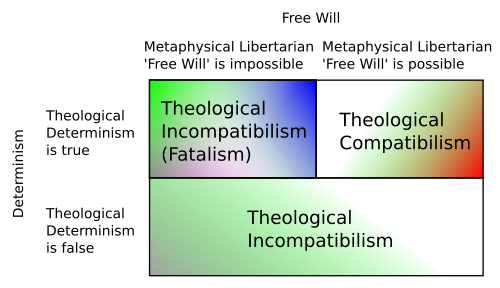
The relationship between divine knowledge and human agency is a central debate in metaphysics. Strong theological determinism is typically viewed as incompatible with metaphysical libertarian free will, often leading to theological fatalism. Conversely, soft theological determinism—or theological compatibilism—argues that human choice can coexist with divine foreknowledge. Proponents of this view suggest that while a deity knows the future, this knowledge does not causally influence or force human actions.
Arguments for Theological Fatalism
The argument for theological fatalism follows a logical progression: if a deity has infallible foreknowledge, then the future is fixed. If the future is fixed, there are no alternate possibilities for human action. Consequently, if one cannot do otherwise, they cannot be said to possess libertarian free will.
أسئلة شائعة
What is the difference between strong and weak theological determinism?
Strong theological determinism claims a deity actively dictates all events, while weak theological determinism suggests that events are fixed simply because a deity has infallible knowledge of the future.
Is theological determinism compatible with free will?
It depends on the interpretation. Hard theological determinists argue it is incompatible, while theological compatibilists believe that divine knowledge does not necessarily force human choices.
What is theological fatalism?
Theological fatalism is the belief that because a deity knows the future with certainty, humans lack the ability to act differently, thereby negating libertarian free will.